On November 24, 2026, Ethereum’s native token, ETH, was trading near $1,700 after another day of withdrawals from U.S. spot Ethereum exchange-traded funds. Bitmine Immersion Technologies added more ETH over the same period. Those are different actions: money moving in and out of fund shares, and a company buying tokens for its own treasury.
Where ETH traded
According to crypto.news market data, ETH traded at $1,702.20 on November 24, down 1.61% over 24 hours. Earlier in the session it was at $1,698.66 after ranging between $1,669.25 and $1,842.19. Bitcoin fell 1.5% to $60,424. The report said Ethereum had struggled to hold a recovery from a recent low below $1,600, with uncertainty about U.S. monetary policy still weighing on sentiment.
ETH is the token used on the Ethereum network. A large balance is a holding of tokens. It is not ownership of the network, a vote that rewrites the protocol, or a claim on other people’s ETH. The prices below are observations and chart references from this report, not a schedule for where the token must trade.
What the ETF numbers measure
A U.S. spot Ethereum ETF is a fund whose shares give investors exposure to ETH through a brokerage product. Net outflows mean more money left those funds than entered them that day. That is not the same event as a wallet sending ETH, and it does not change what holding the token allows.
Data attributed to SoSoValue showed that U.S. spot Ethereum ETFs recorded $84.96 million in net outflows on November 23. The total still included a gain at one fund: Fidelity’s Ethereum Fund (FETH) recorded $5.58 million in net inflows.
Those withdrawals followed about $305.8 million in weekly ETF outflows from November 16 to 20, when Ethereum’s price fell nearly 13%. The selling was not limited to Ethereum funds. U.S. spot Bitcoin ETFs recorded nearly $570 million in net withdrawals on Monday, November 23, a fifth straight session of outflows.
The report also noted a pending inflation release. The Bureau of Economic Analysis had scheduled October’s personal consumption expenditures (PCE) data for November 25 at 8:30 a.m. ET. The Federal Reserve uses the PCE price index when it assesses inflation and considers interest rates. The article does not report what that release showed.
Bitmine’s ETH is a treasury holding
Bitmine kept to a weekly buying plan. In its November 23 announcement, the company said it had purchased another 7,819 ETH over the previous week. Total holdings were 6,085,564 ETH as of November 22.
That was about 4.98% of an estimated circulating supply of 122.2 million ETH, leaving Bitmine about 24,436 ETH short of a 5% target. Circulating supply is the estimated pool of tokens already issued and counted as available. A share of that pool is not a share of the Ethereum network.
Executive Chairman Thomas Lee said the company had maintained its purchasing schedule since it adopted an Ethereum treasury strategy in June 2025. “Over the past week, we acquired 7,819 ETH,” Lee said.
At the company’s reference price of $1,713 per ETH, the remaining tokens needed to reach the 5% mark would cost about $41.9 million, and only if circulating supply stays unchanged. That is arithmetic from Bitmine’s reference price, not a claim that ETH will remain at $1,713.
Bitmine has staked 5,227,037 ETH, nearly 86% of its Ethereum holdings. In this report, staking means ETH the company has committed through Ethereum’s staking process, separate from tokens it simply holds. Lee estimated that this existing staking position could generate about $245 million in annualized revenue. That is his estimate for Bitmine’s staked balance. It is not income that comes automatically with holding ETH, and it is not a stated return for ETF shareholders.
One analyst’s levels
Crypto analyst More Crypto Online, in a November 24 post on X, pointed to $1,681.39 as the immediate area to watch. That figure is the 50% Fibonacci retracement of the drop from the recent high — a chart marker halfway through a prior price move, not a rule built into the token.
The analyst read the decline with Elliott Wave theory, a method that sorts price swings into repeating wave shapes. “The decline from the last high looks like a 5-wave move, and the price is now testing the 50% retracement at $1,681.39,” the analyst wrote. In that view, the retracement might be deep enough to complete the current corrective wave, but the five-wave shape could mean it is only the first leg of a larger correction. The analyst suggested a possible bounce, then another decline toward a support zone extending to $1,595.
The same note treated the recent swing low of $1,538.60 as a further downside reference if selling resumed, and resistance around $1,826 if ETH sustained a recovery above $1,700. These are one analyst’s reference points. They are not activated network changes, and they are not confirmed losses.
What the daily chart showed
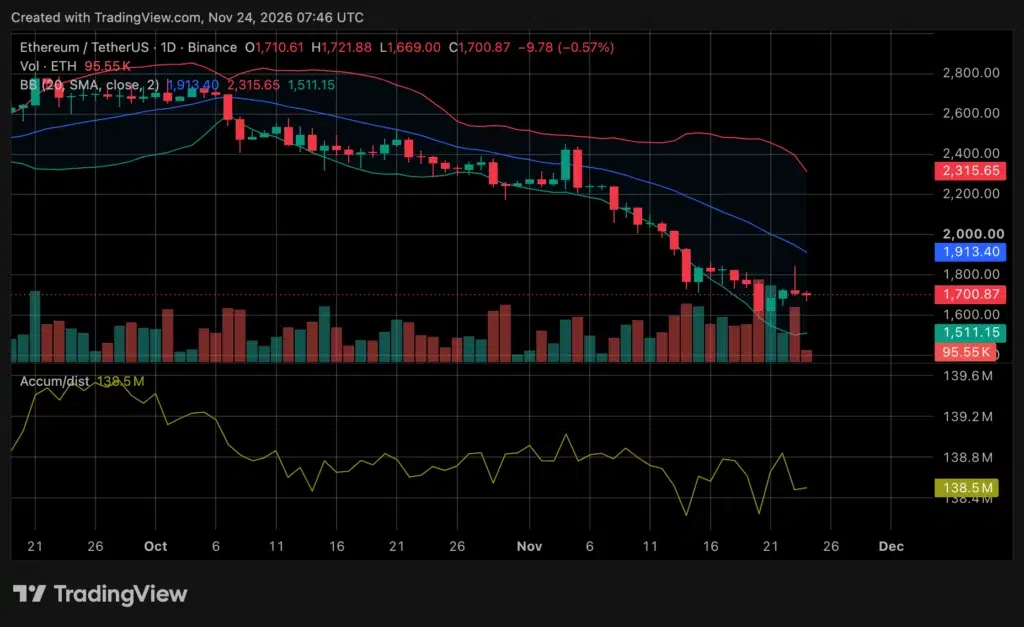
On the daily chart in the crypto.news report, Ethereum was in a downtrend of lower highs and lower lows and was trading below its 20-day simple moving average of $1,913.40. That average is the middle line of the Bollinger Bands. The gap between the bands was relatively wide, which the report read as elevated price volatility.
If ETH fell below nearby support at $1,669.25, the next levels the report said to monitor were $1,600 and the lower Bollinger Band at $1,511.15. On the upside, a recovery above $1,800 would bring the recent high of $1,842.19 into view, then resistance near the 20-day average.
Ethereum’s Accumulation/Distribution indicator had declined to 138.5 million from a recent recovery near 138.8 million. The report read that as selling pressure still outweighing accumulation on the daily chart. The reading is a chart statistic. It is not a count of the ETH held by Bitmine or inside the ETFs.
What these figures do not grant
An ETF outflow is a flow of money in fund shares. It does not, on its own, change ETH’s supply or give remaining holders new permissions.
Bitmine’s roughly 4.98% is a share of estimated circulating tokens. It is not 4.98% ownership of Ethereum, and the 5% target described in the announcement is still a token-balance goal.
The roughly $245 million figure is Lee’s estimate for Bitmine’s already staked ETH. Holding ETH, or holding an ETF share, does not by itself assign that revenue to the holder.
The support and resistance prices are reference points from the November 24 report and from one analyst’s chart reading. They are not protocol upgrades and not a promise about future returns.