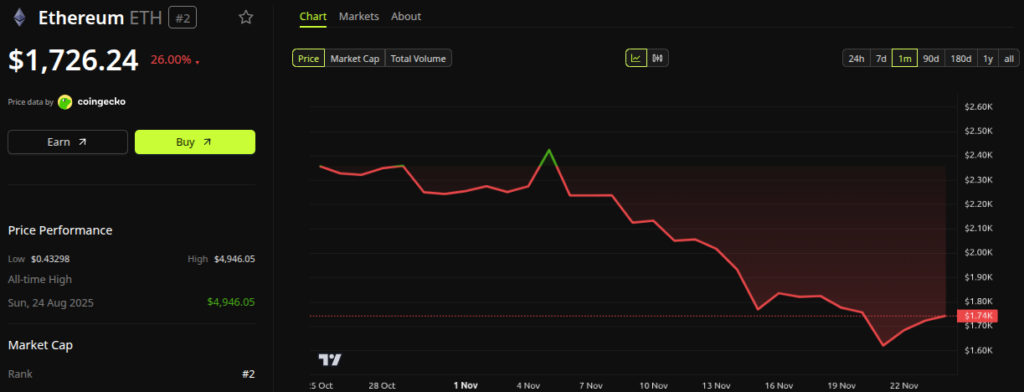
As reported on November 24, 2026, BitMine bought 7,819 ether (ETH) in the preceding week. Its November 23 treasury update put its holdings at 6,085,564 ETH, or 4.98% of Ethereum’s total supply. BitMine chairman and Fundstrat co-founder Tom Lee argued that ETH qualifies as “hard money” alongside bitcoin (BTC). His comparison was about how fast the supply of each asset grows, not how its price performs.
What Lee means by “hard money”
Hard money describes an asset whose supply grows slowly and predictably. Lee said ETH supply had grown 1.26% since June 30, 2025, when BitMine adopted its Ethereum treasury strategy. That works out to roughly 0.9% a year, compared with about 0.82% for bitcoin. Lee contrasted those rates with annual supply growth of 7.6% for Solana, 5.4% for XRP and 2.9% for Cardano.
“In other words, ETH and BTC have essentially the same inflation rate,” Lee said. Here, inflation means growth in the number of tokens. It does not measure what those tokens can buy or guarantee that their price will hold up. On November 23, ETH traded near $1,727, down almost 28% over the preceding month.

How much of BitMine’s ETH was staked?
BitMine’s ETH was worth about $10.4 billion as of November 22. Of that position, 5,227,037 ETH, worth roughly $9 billion, was staked—committed to helping secure the Ethereum network in exchange for rewards. BitMine reported about $245 million in annualized staking revenue. It estimated that staking its entire ETH position at a 2.74% yield could bring that figure to $286 million. The latter was a projection, not revenue already earned.
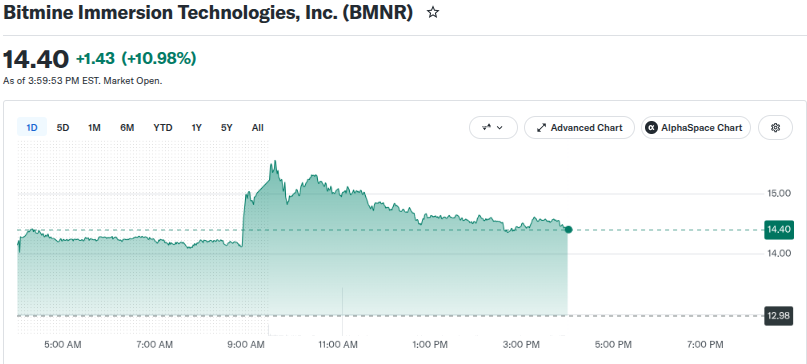
BitMine reported $11.1 billion in total holdings, including 216 BTC, $384 million in cash and marketable securities, a $180 million stake in Beast Industries and a $54 million stake in Eightco Holdings. Its shares (BMNR) rose nearly 11% to $14.40 on November 23 after briefly trading above $15 at the open. Even after that rebound, the shares were down about 54% for the year to date.