Reporting dated November 24, 2026 described Binance users whose balances were locked after a U.S. court order. One trader on X claimed that about 400,000 USDT was locked. That figure is the trader’s claim, not a confirmed total.
USDT is a stablecoin: a token meant to track the U.S. dollar. Holding it in an exchange account is not the same as holding cash you alone control. It also does not guarantee that the exchange can send the tokens back whenever you ask. An exchange balance is custodial, meaning the platform holds the assets and must follow a court order that applies to it.
What the Colorado order required
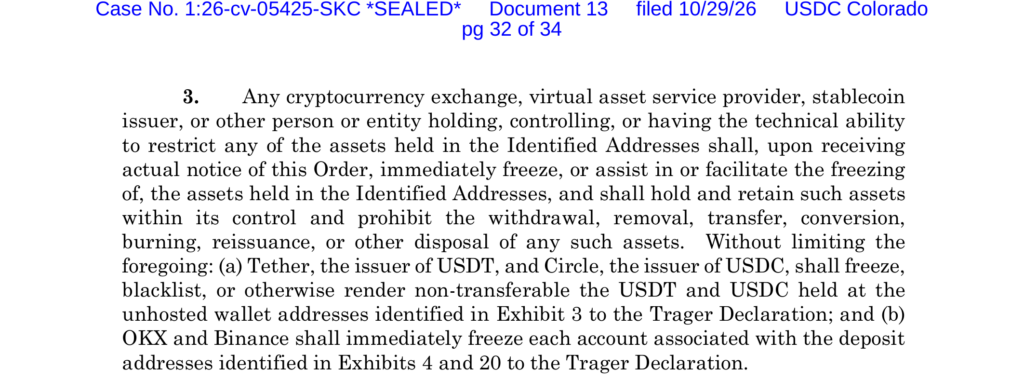
On October 29, 2026, a Colorado judge signed a temporary restraining order, a short-term court order, aimed at Huione Group and Xinbi. The order treats those two Southeast Asian networks as accused of laundering criminal proceeds. That is an accusation in the case, not a conviction established in this report.
The U.S. Treasury has said Huione laundered at least $4 billion between 2021 and 2025. TRM Labs has said Xinbi processed more than $24 billion, mostly in USDT on TRON. TRON is the network those tokens moved on. USDT is the token. Using a token on a network does not make the holder an owner of that network, and it does not confer a governance role.
The order instructed Binance and OKX to freeze accounts linked to specified deposit addresses. Plaintiffs served notice on 27,304 TRON addresses. Tracing of that kind can also capture funds that belong to people who are not the targets of the case.
Because the case was sealed, Binance support could at first refer only to a “Sealed Case Name.” On November 23, 2026, Binance said unrelated accounts could be affected and that the exchange cannot release those funds on its own. The order was set to remain in effect until November 27, 2026, unless a court extended it. Affected users had until November 24, 2026, to contact the plaintiffs’ lawyers and raise objections.
In a public post on November 23, Binance pointed to its own explanation of how court-ordered freezes work, why they can happen, what the exchange can and cannot do, and what information affected users may receive. The company described protecting users and meeting legal duties as core responsibilities.

Three different ways tokens get stuck
A court freeze of a balance held at an exchange is not the same thing as an issuer blacklist, and neither is the same as a later criminal seizure.
On the same night the Colorado judge signed the order, Binance was itself the victim of a major hack. Tether, the company that issues USDT, blacklisted 971 million USDT within 57 minutes. A blacklist, in this setting, is the issuer blocking those tokens from moving in the usual way. Within about 12 hours, issuers and protocols had frozen $2.84 billion, according to Recoveris. That step came before any court ruling. U.S. prosecutors later secured approval to seize $1.2 billion.
Separately, on November 18, 2026, Binance obtained a $6.5 billion worldwide freezing order from a court in Abu Dhabi. That order covered approximately 26,000 wallets, including parties Binance does not accuse of wrongdoing. Powers like these can help recover stolen funds. They can also restrict people who have not been accused.
An English court has previously lifted a freezing order after the applicant failed to disclose that a wallet held pooled funds belonging to exchange customers. The report does not give the date of that English case.
What a freeze does not decide
During a BeInCrypto Market Intelligence Expert Council discussion, Erica Stanford, an adviser at the law firm CMS, said there are legitimate uses for freezing crypto assets. She also warned against a system in which governments can, at will, freeze money, seize it, or stop someone from having it. Patrick Prinz, co-founder of Recoveris, said he wanted a clear policy for seizing and freezing, and pointed to the difference between how private companies and law enforcement restrict assets.
Tokens can be moved, and large sums can be frozen, within minutes. Court process is slower. For someone whose exchange balance is locked, that gap can mean weeks without money they use day to day, even when they have not been accused of a crime.
A freeze limits access. By itself, it is not a finding that the holder did anything wrong, and it is not a promise that the tokens will be returned on a fixed date. Whether a particular balance can be unfrozen depends on the court order, the exchange’s legal duties, and any objection the holder is allowed to file.