Originally reported November 16, 2026. Traditional banks, payment networks and existing stablecoin issuers were expanding their efforts to move dollars on blockchain networks, according to Decrypt’s report. Some products were operating; a proposed bank consortium had yet to launch a token.
A bank-backed stablecoin remains a plan
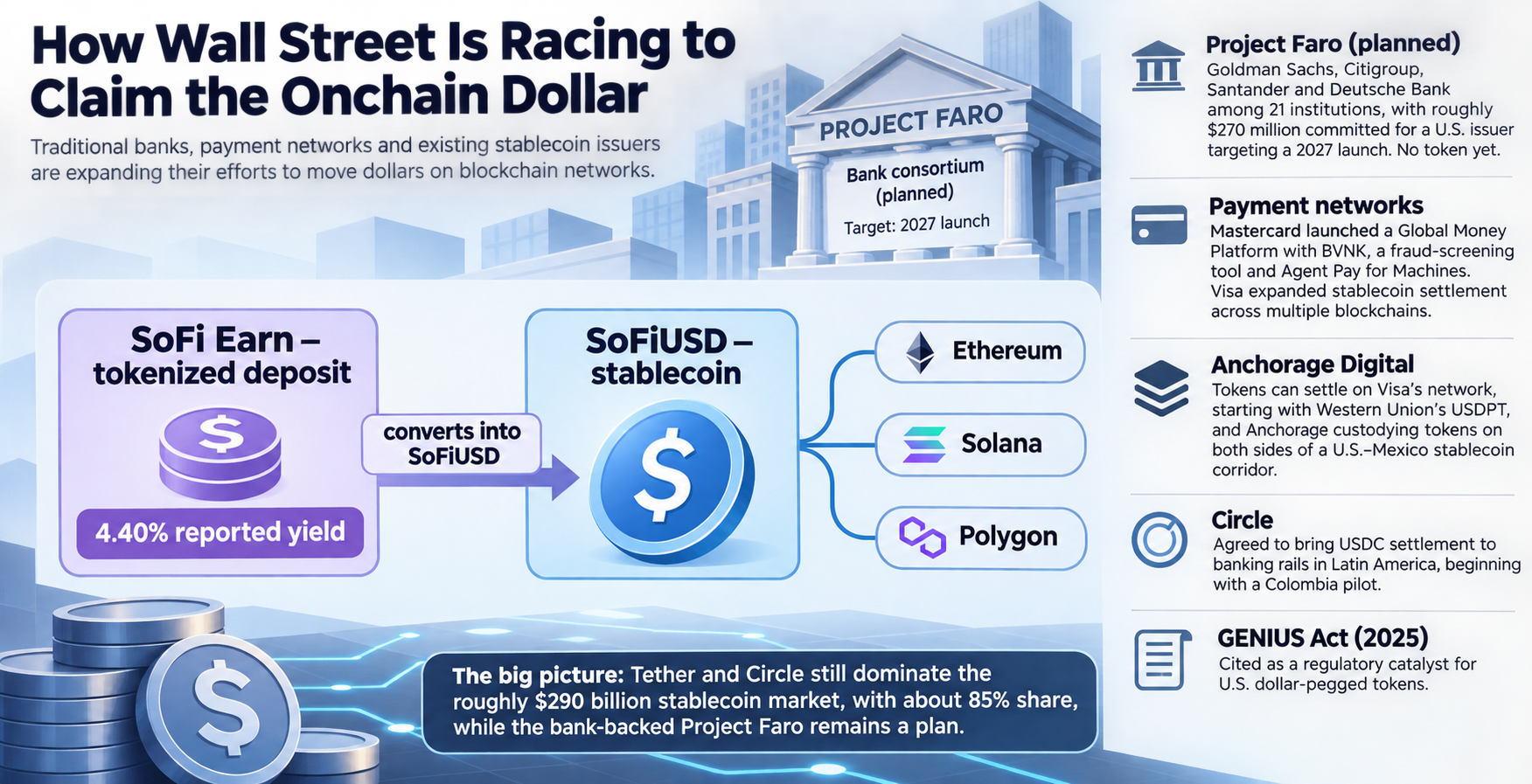
Goldman Sachs, Citigroup, Santander and Deutsche Bank were reported to be among banks committing roughly $270 million to a joint dollar-stablecoin venture codenamed Project Faro. The funding was intended to cover five years of operations for a U.S.-incorporated issuer targeting a 2027 launch. The coalition had grown from 10 institutions to 21.
The proposed issuer would compete with Tether and Circle, which the report said together controlled about 85% of a roughly $290 billion stablecoin market. As of the original report, Project Faro had no token, CEO or final name.
What was already operating
SoFi’s SoFiUSD, described in the report as the first stablecoin from a U.S. national bank, had expanded to Polygon alongside Ethereum and Solana. SoFi had more than 17 million members. It had also launched SoFi Earn, a separate tokenized deposit paying 4.40% yield that converts into SoFiUSD. That reported yield applies to SoFi Earn, not to holding SoFiUSD. SoFi was also settling its card program over Mastercard’s network.
For payment settlement, Anchorage Digital’s tokens could settle transactions on Visa’s network, starting with Western Union’s USDPT. The report also described Anchorage as custodying tokens on both sides of a U.S.–Mexico stablecoin corridor. Mastercard had launched a Global Money Platform with BVNK, a payment-fraud screening tool and Agent Pay for Machines, while Visa had expanded stablecoin settlement across multiple blockchains. Circle had agreed to bring USDC settlement to banking rails in Latin America, beginning with a Colombia pilot.
The report cited the GENIUS Act, signed in 2025, as a regulatory catalyst for U.S. dollar-pegged tokens. It also noted the limit of the shift so far: Tether and Circle remained dominant, while the proposed bank-backed issuer still had to launch.
Source: decrypt.co (originally published 2026-11-16 00:01 UTC+8)