Historical roundup: Originally reported by BlockBeats on November 16, 2026, at 12:03 p.m. UTC+8, covering developments from November 9–15.
The week’s updates included a completed on-chain vote to allocate more ARB for incentives, a preliminary vote on a proposed Aave V4 collateral change, and several new ways to use or access tokenized assets. The distinction matters: a governance vote does not necessarily mean a feature is live.
Governance, incentives and buybacks
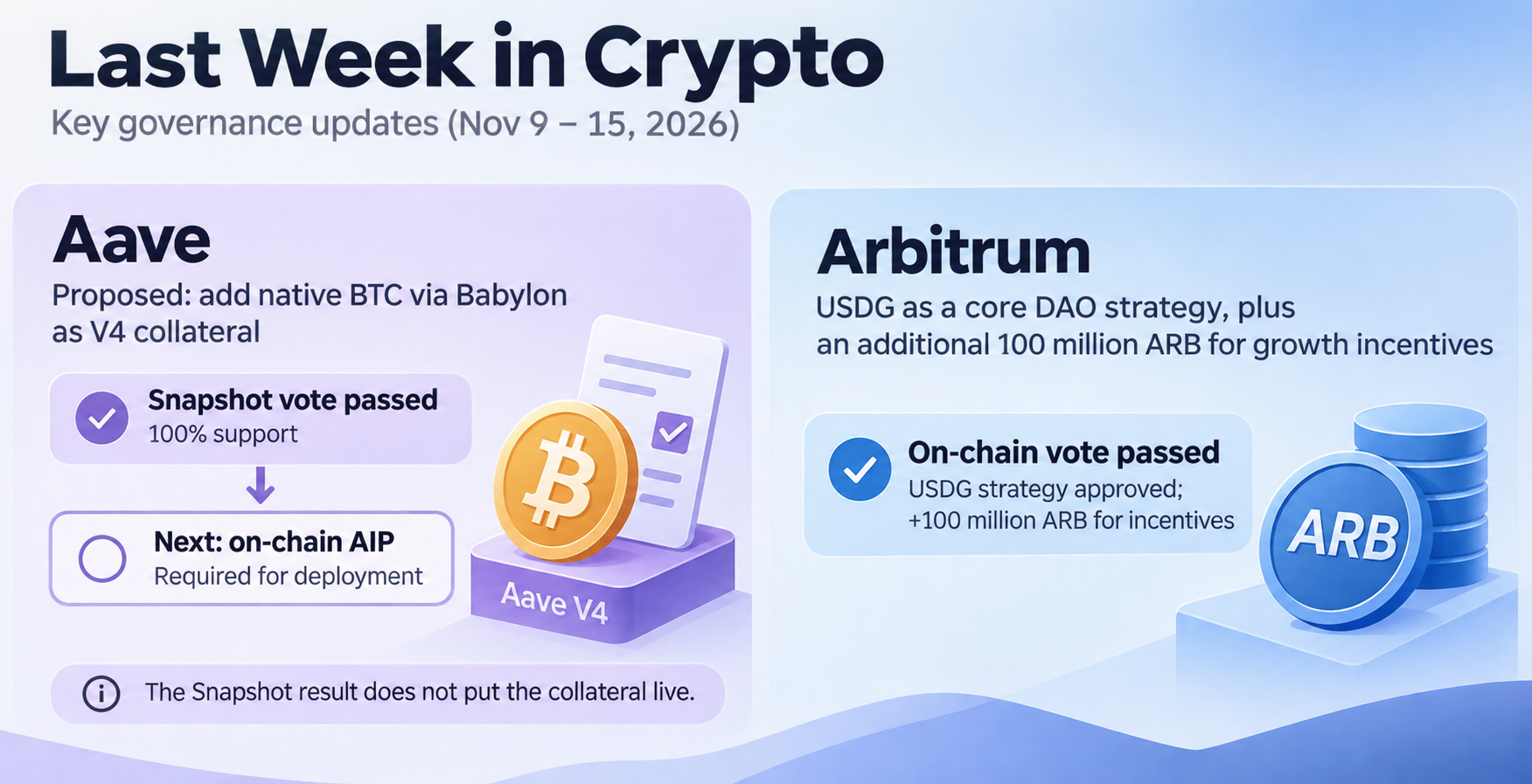
- Arbitrum: An on-chain vote passed to make USDG a core DAO strategy and approve an additional 100 million ARB for related growth incentives. The approval concerns an incentive allocation, not a reported token unlock.
- Aave: A Snapshot vote passed with 100% support for introducing native BTC through Babylon as Aave V4 collateral. Deployment still requires an on-chain Aave Improvement Proposal (AIP); the Snapshot result alone does not put the collateral option into use.
- World Liberty Financial: The project said it completed the first $1 million repurchase under a new buyback plan. The source did not specify the number of tokens repurchased.
- Cosmos Hub: Cosmos announced it would contribute IBC, its inter-blockchain communication protocol, to Linux Foundation Decentralized Trust and maintain it with Datachain and OpenZeppelin.
Wallets, trading and tokenized assets
- Gram: Telegram founder Pavel Durov said more than 700,000 self-custody wallets had been created in the preceding 48 hours. He said receiving GRAM automatically activates a wallet.
- Pump.fun: Its app added trading for tokens in the Optimism, Sei and Unichain ecosystems, bringing its cumulative supported chain count to 20.
- Jupiter: It announced a phased rollout over the following days of Pulse for asset research, Baskets for subscribing to token baskets, Vaults for third-party-managed yield vaults, and Portfolio V3. Vaults was to enter private testing first.
- Ether.fi: Its app added native minting and redemption of xStocks on OP Mainnet for eligible users, providing access to more than 1,500 tokenized stocks in place of the app’s previous wrapped-asset process. The native xStocks assets had already operated on OP Mainnet for months; the new development was access to minting and redemption within Ether.fi’s app.
- Ondo: It brought Fidelity’s FCAT into its cross-chain verification system for stock tokens; relevant transfers must be verified by FCAT.
Stablecoins, lending and market data
- Ethena and Securitize launched a round-the-clock stablecoin conversion tool for eligible investors in BlackRock’s BUIDL fund. Its initial $50 million in liquidity comprised $25 million USDC and $25 million BUIDL. Capacity could reach $100 million, subject to conditions including fund availability. BUIDL is BlackRock’s U.S. dollar institutional digital liquidity fund.
- Polygon: SoFiUSD launched on Polygon. The SoFi app supports buying, selling, holding and converting it, with 1:1 U.S. dollar redemption through SoFi Bank.
- Frax: Third-quarter frxUSD lending rose from $16.5 million to $30.3 million, about 83% quarter over quarter. Frax also launched a CrossWorlds-managed Morpho frxUSD vault offering a borrowing entry point for Stake DAO liquidity-provider positions paired with sfrxUSD, sUSDe and USD3, among others.
- Figure: Third-quarter loan-market volume was $5.8 billion, up 135% year over year; $677 million came from Kiavi, consolidated in September. Figure also reported that YLDS in circulation rose from $328 million at the end of 2025 to $504 million at the end of September 2026, with 28 participants using it for settlement.
- Pyth: Pyth Data Marketplace added NYSE BQT, distributing real-time prices and trading-halt and resumption status from five NYSE Group stock exchanges. Customers must first obtain authorization from NYSE.
- Monad: It joined Visa’s stablecoin settlement network. Participating issuers and acquirers can settle Visa payables using stablecoins on Monad.
Team and product plans
Maple Finance’s CEO confirmed that co-founder Joe Flanagan and COO Ryan had decided to leave over differing views on the company’s direction; Joe was to help with the transition through year-end. MegaETH co-founder Shuyao Kong said a restructuring had cut 20% of staff across its public-chain, wallet and ecosystem teams, while founders and the core engineering team remained. Its foundation had previously reorganized as MEGA and committed $30 million from its existing treasury to new products, starting with an AI inference product planned for December 2026. That commitment was not new financing, and the product had not launched at the time of the report.
Source: theblockbeats.info (originally published 2026-11-16 12:03 UTC+8)