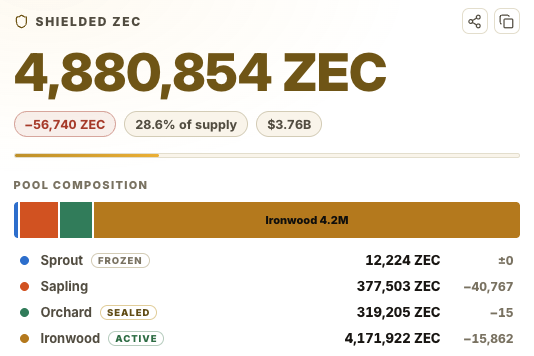
Zakura called on Zcash to stop new payments into Sapling, an older privacy pool that held nearly 400,000 ZEC, or about 2% of the ZEC supply. The November 26, 2026 analysis described a precaution Zcash could take through a network upgrade, not a restriction already in force. It reported neither a successful attack nor a loss of funds.
What would be at risk?
A privacy pool lets users transact privately. Sapling uses a zero-knowledge proof to check that a transaction is valid without revealing its private details. The proof system relies on a mathematical technique called a pairing. Users’ private keys and the records that commit to their private holdings, called note commitments, do not.
That distinction matters for both risk and recovery. If someone could break the pairing-based system, they could forge a proof that Sapling would accept as valid. They would not need to obtain a user’s private key. But if Zcash froze the pool before it accepted a forged proof, the existing note commitments could still serve as the basis for recovering funds. Developers would need to build a replacement proof system that checks the same rules without relying on pairings. Recovery is a contingency plan, not a feature already deployed.
Zakura said the hypothetical break would not compromise Zcash’s transparent funds or funds in its newer privacy pool, Ironwood. The concern is about how Sapling verifies transactions, not about every ZEC on the network. Pairings also play a role in some other zero-knowledge systems and in consensus signatures on networks including Ethereum and Solana. A break affecting those signatures would require a change in how validators sign, not necessarily a change to ordinary users’ account keys.
Why stop deposits rather than freeze the pool now?
Zakura proposed two distinct steps: disable incoming payments through a network upgrade, then be ready to freeze the entire pool if credible evidence of a threat emerges. The analysis encouraged Sapling users to move their ZEC to Ironwood and said most wallets already supported both pools.
In the 30 days preceding the analysis, fewer than 2.6% of Zcash transactions used Sapling. Zakura identified 66% of those transactions as miner fund flows and considered it likely, though not established, that miners accounted for much of the rest. Miners receiving payments in Sapling could switch to Ironwood, the analysis said.
Why the AI claims do not establish a break
Zakura’s analysis referred to a claimed AI proof of the Riemann hypothesis and to separate, unconfirmed reports of an AI advance in factoring large integers, the problem underlying RSA cryptography. It did not establish a practical method for breaking Sapling. Factoring and attacks on pairing-based cryptography use related algorithms, but an improvement in one need not carry over to the other. In particular, a better estimate of how many numbers meet an algorithm’s requirements is not the same as a faster way to find them.
As a practical benchmark, Zakura cited Cognition’s September 2026 factorization of RSA-260, an 862-bit integer. Cognition reported that its GPU implementation cut costs tenfold relative to the previous best public approach. That was a measured improvement on a specific problem, not a demonstration against Sapling. Even assuming an unverified billionfold speedup at relevant sizes, Zakura estimated a cost of $1 trillion to $300 trillion and months or years of computation. Those figures were projections, not observed attack costs.
Separately, Zakura said a proposal was in preparation for transparent Zcash transactions to use SLH-DSA-192, a hash-based signature scheme targeting 192-bit security against future threats, including quantum computing. That proposal concerns how transparent transactions are signed; it is not the proposed replacement for Sapling’s proof system. Neither change was described as active.