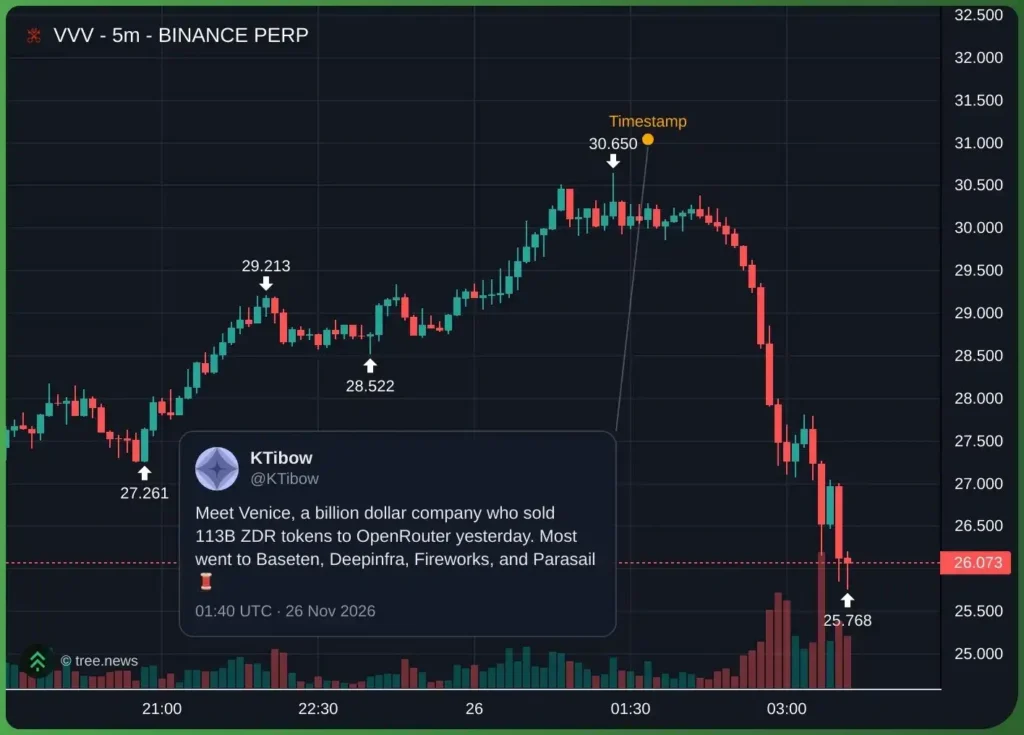
Venice’s VVV token fell from above $30 to about $25.80 on November 26, 2026, a drop of roughly 15%, as developer KTibow challenged the AI service’s privacy claims. VVV had gained about 33% over the preceding week despite a weak broader market.
The dispute turns on a distinction that matters to anyone sharing sensitive material with an AI model: a provider’s promise not to keep a conversation is different from a technical safeguard that prevents it from reading one. Venice founder Erik Voorhees acknowledged that some descriptions of where its models run needed updating. He disputed the suggestion that Venice could read chats sent using its end-to-end encryption option.
Who processes a Venice chat?
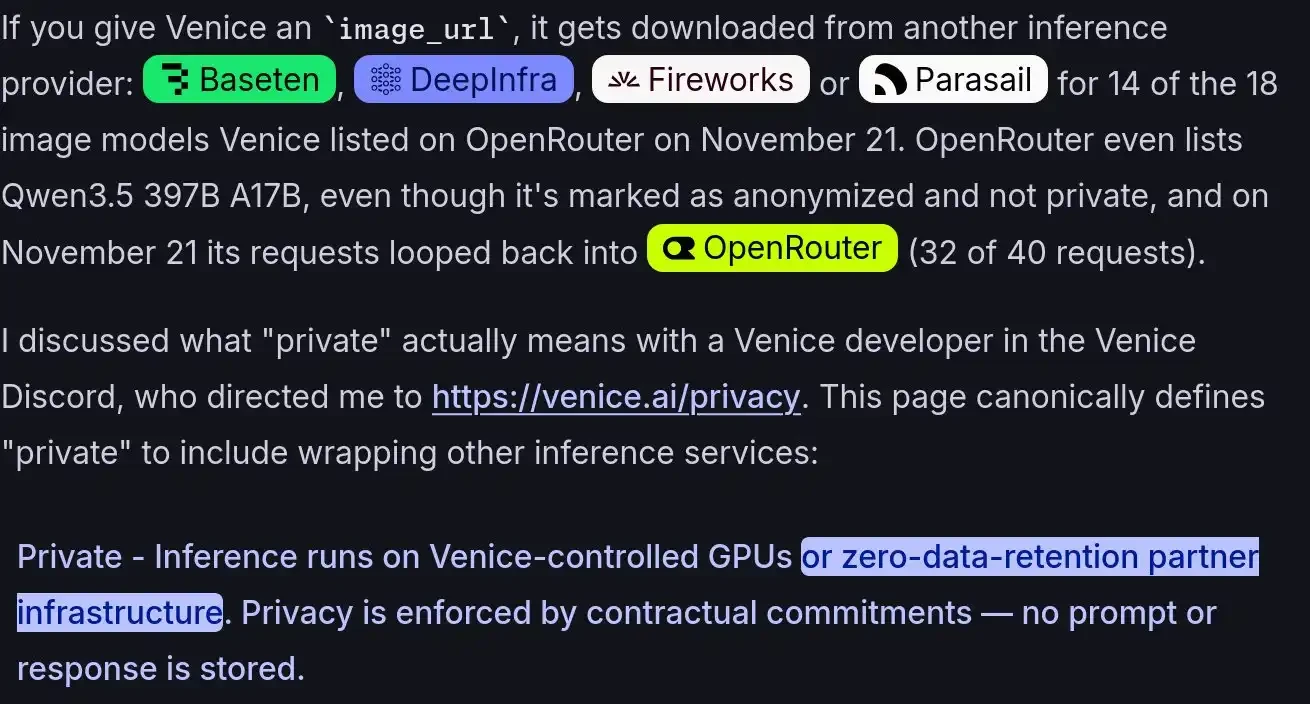
Some Venice pages said its models ran on self-hosted servers. KTibow said that when he sent image links to 18 models, requests to retrieve the images came from outside providers, including Baseten and DeepInfra, in 14 cases. He argued that Venice had not made those providers’ role clear to users. The requests indicated outside involvement; they did not establish that a provider retained a conversation.
Voorhees said Venice had brought in more partners as it grew. Some models run on servers Venice controls, while partners run others under agreements to use prompts and replies only to answer the request and not to store them afterward. The protections Venice describes depend on the mode:
- Anonymous mode: Venice forwards the prompt without the user’s account identity. The model provider can still read the prompt.
- Standard privacy mode: Venice or a partner processes the conversation and promises not to retain the prompt or reply.
- Trusted execution environment (TEE): The model runs in a hardware-isolated environment designed to prevent the server operator from viewing the content during processing.
- End-to-end encryption: The user’s device encrypts the message before sending it. Venice says it forwards only encrypted content, which is decrypted for processing inside a verified, isolated environment.
KTibow questioned whether some older encryption flows could allow an intermediary to recover earlier messages. Voorhees said no one had demonstrated the alleged attack and asked researchers to submit any specific vulnerability to the relevant Phala or NEAR team. Dragonfly investor Tom Schmidt criticized KTibow for not distinguishing among the four modes.
KTibow also showed records of Venice’s homepage sending tracking requests to Meta, Google and TikTok. That finding concerns tracking on the website, not evidence that those advertising platforms received chat content.
What VVV gives users
Venice lets consumers use different models for chat, writing, images and video. Developers can access those models through an application programming interface, or API, to power features in their own products. In May, Delphi Digital co-founder Yan Liberman pointed to integrations including OpenRouter, Fleek and Brave Leo as evidence that Venice was becoming a model provider for other applications, not just a consumer chat service.
Liberman’s subscription figures put the annualized revenue from new subscriptions at about $1.9 million for April 26–May 2 and $2.6 million for May 10–16. He estimated Venice’s overall annualized revenue at about $60 million in May. Voorhees announced a $100 million annualized rate on August 17; by November 23, the reported rate exceeded $200 million. These figures express revenue at a yearly pace, not revenue already collected over a full year.
VVV’s link to that business is through usage credits and buybacks. Users can stake VVV to receive sVVV, then lock the sVVV to create a token called DIEM. Each staked DIEM provides $1 in API spending credit per day, not a $1 cash payment. The right to use that computing capacity can be traded. To recover the locked sVVV, the user who created the DIEM must burn the corresponding amount of DIEM.
Under a plan announced in July, Venice committed 5% of API credit sales to buying back and burning VVV. Its Minds feature, launched November 17, added another use: people can publish task-specific AI agents on the Mind Market and charge a markup. Creators receive 90% of the markup in platform credits, while the remaining 10% goes toward VVV buybacks. Users can also burn tokens to raise a Mind’s ranking. Those mechanisms concern access and platform fees; holding VVV does not determine who can read a chat.
Wallet movements do not confirm sales
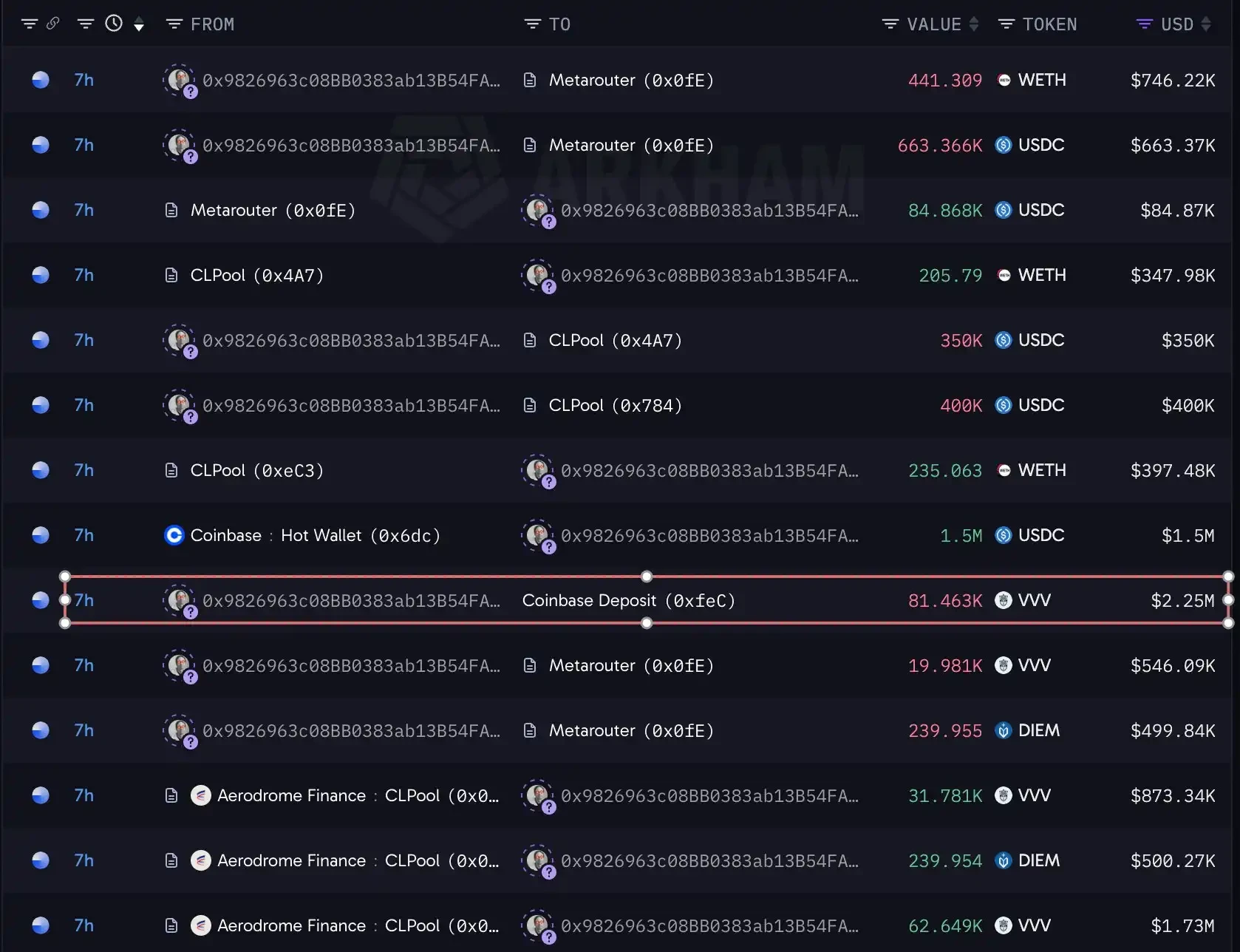
Lookonchain reported that a wallet it suspected was linked to Voorhees transferred 81,463 VVV to Coinbase, worth about $2.25 million at the time. The wallet still had about 675,000 VVV staked when Lookonchain checked. Neither the wallet’s ownership nor a sale by Voorhees was confirmed.
Two other large wallets had requested to unstake tokens before KTibow’s November 26 post. A wallet beginning 0x331c requested to unstake about 200,000 VVV on November 23; one beginning 0x6776 requested to unstake about 500,000 VVV on November 24. Those requests show that holders sought to unlock tokens, not that they sold them.