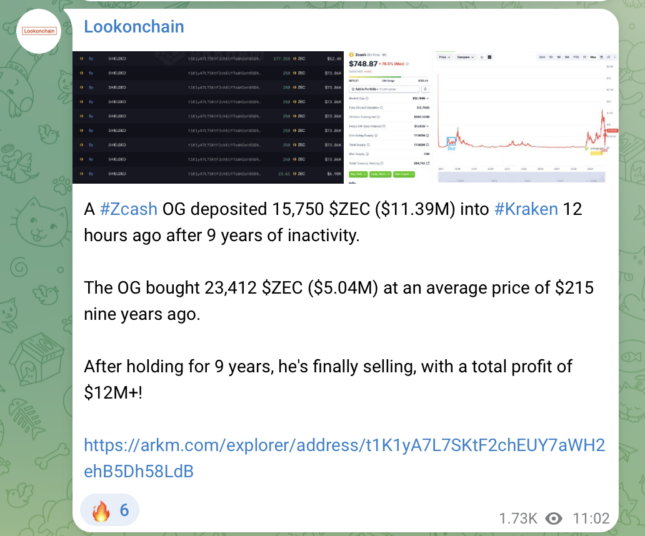
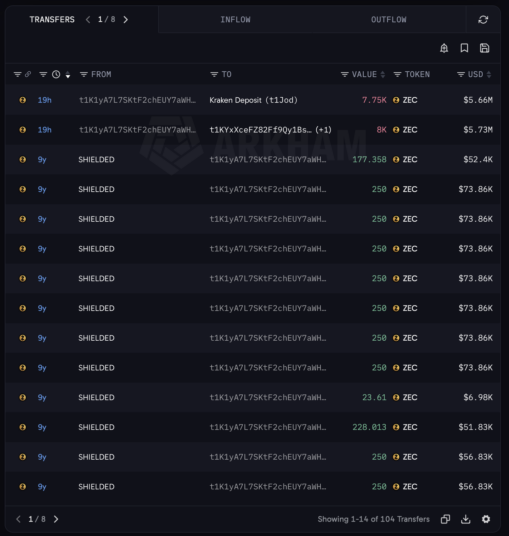
On November 26, 2026, blockchain monitoring platform Lookonchain reported that a Zcash wallet had moved 15,750 ZEC, valued at about $11.39 million, after nine years of inactivity. Lookonchain linked the transfers to Kraken, with at least 7,750 ZEC sent to a deposit address at the exchange. The deposit does not establish that the holder sold the coins.
What the transferred coins were worth
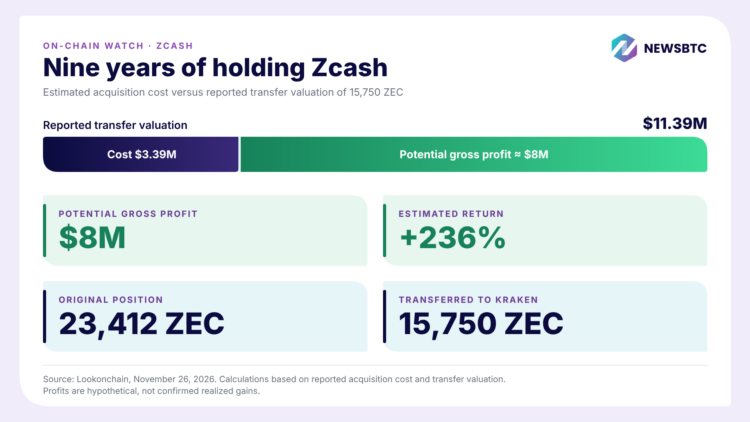
Lookonchain estimated that the holder acquired 23,412 ZEC in 2017 at an average of about $215 per coin, for a total of just over $5 million. The 15,750 ZEC transferred represent roughly two-thirds of that position. At the reported transfer valuation of about $723 per coin, those coins were worth roughly $8 million more than their estimated cost. Selling at that price would have meant a gain of about 236% on the transferred coins.
That distinction matters for Lookonchain’s claim that the holder was selling with more than $12 million in total profit. Neither a sale nor that realized profit is verified, and the estimated $215 purchase price is not a confirmed trading record.
The same distinction applies to losses. ZEC traded around $16 to $20 for much of 2024 and early 2025. At $20, the original position would have been worth less than $470,000 if it had remained intact. That would have been a paper loss of more than 90%, not evidence that the holder sold at a loss.
Why a Zcash transfer can be visible
ZEC is the coin used on the Zcash network. Although Zcash supports private transfers, privacy is not mandatory. Balances and transfers involving transparent addresses are publicly visible. Shielded transactions, by contrast, use a method called zero-knowledge cryptography to conceal transaction details.
That design lets observers trace some movements, including an apparent exchange deposit, without revealing the holder’s private trading history. The visible activity does not establish who controlled the wallet throughout the nine years, whether ownership changed privately or what the holder did after the coins reached Kraken.