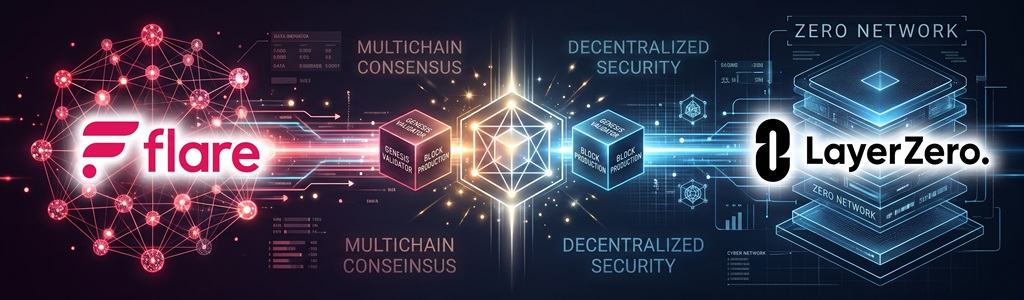
Flare announced on November 27, 2026, that it would help produce and verify the first blocks on LayerZero’s Zero Network. When the news was reported on November 28, 2026, at 09:03 UTC+8, the mainnet had not yet launched. Flare will serve as a genesis validator, meaning it will take part in validating the network from its first block.
How ZRO factors into block approval
Zero’s validators vote on whether to approve a block. The weight of each validator’s vote depends on how much ZRO it stakes, not simply how much it holds. The network’s design calls for additional validators to join gradually after launch.
Flare CEO Hugo Philion said the role extends Flare’s collaboration with LayerZero to consensus: the process by which validators agree on which blocks to accept. According to Flare’s technical reports, Zero will be the second external network where Flare takes on consensus duties. In October 2026, the XRP Ledger Foundation added Flare to its list of recommended validators.
Zero is compatible with the Ethereum Virtual Machine and is designed for global financial markets. Project specifications describe it as the underlying network for LayerZero ATLAS, an on-chain trading engine designed to verify trades and provide instant settlement for exchanges.
Verifying cross-chain messages is a separate role
Flare’s FXRP asset already uses LayerZero’s Omnichain Fungible Token (OFT) standard to support transfers between blockchains. Ahead of Zero’s mainnet launch, Flare also planned to make its Decentralized Verifier Network available to OFT issuers starting in early December 2026.
Unlike a Zero validator voting on a block, the verifier network checks messages about activity on another chain. Its 100 independent data providers check events on the chain where they occurred. A message is confirmed only when a majority, weighted by stake, agrees. This work draws on the Flare Data Connector, which also supports FAssets, Flare Smart Accounts and FXRP.