Ethereum developers scheduled the Glamsterdam upgrade for December 15 on Hoodi, a test network, after reviewing how a proposed change to gas charges could affect existing smart contracts. As of the November 27, 2026 report at 14:24:27 UTC+8, Ethereum’s main network had no activation date.
The Hoodi test was originally scheduled for October 26. Developers postponed it after security researchers flagged compatibility risks. At their November 26 All Core Developers Consensus meeting, the teams reached what the meeting summary called a “rough consensus to proceed with the current Glamsterdam spec as is.” Activation on Hoodi was scheduled for epoch 143616, at 19:12 UTC on December 15 (03:12 Beijing time on December 16).
What would change for smart contracts?
Ethereum uses gas to measure the resources a transaction consumes. The proposal at the center of the review, EIP-8037, would account separately for the work of executing a transaction and the cost of adding permanent data to the blockchain.
Creating a smart contract currently carries a base charge of 32,000 gas units. Under the proposal, creation would incur 183,600 units of state gas alone, with separate charges for execution and for storing the contract’s code. The proposal’s authors noted that after Ethereum raised its block gas limit from 30 million to 60 million units, the amount of permanent data added each day rose from about 105 MiB to 326 MiB on average.
Glamsterdam had already activated on Sepolia, another test network, on October 6. Developers there began testing a 200 million gas limit alongside changes to block production and transaction processing. Consensus-layer developers also agreed on a way to validate execution payloads through pull request 5770 without introducing consensus-breaking changes.
Why fixed gas budgets matter
A contract that sets aside a fixed amount of gas for an operation may no longer have enough if the charge changes. Fixed budgets accounted for 182 of the 200 compatibility findings identified in an assessment by the Ethereum Foundation, ChainSecurity and Dedaub. Of the 200 findings, three were rated high severity, 30 medium and 167 low. Most could be addressed through configuration changes, but 24 required a contract upgrade or migration.
The audit findings are distinct from the estimate of how many contracts might be affected. Ethereum Foundation developer Marius van der Wijden estimated that 10,000 to 15,000 of Ethereum’s roughly 90 million contracts could encounter problems. The foundation contacted more than 50 potentially affected companies to assess how much time they would need for fixes.
Hegotá priorities remain open
For Hegotá, the upgrade planned after Glamsterdam, developers debated whether to retain Fork Choice-Enforced Inclusion Lists, or FOCIL. The mechanism is intended to make it harder for block builders to leave eligible transactions out of blocks. Ethlabs researcher Caspar Schwarz-Schilling argued for reconsidering FOCIL so developers could devote resources to quantum-resistant cryptography. Other participants said both efforts could proceed together.
In a November 24 publication, Ethereum Foundation researcher Kev Wedderburn proposed using Keccak-256 as a common hash function for Ethereum’s post-quantum infrastructure, citing its extensive security research. At Devcon in Mumbai, researcher Justin Drake outlined a late-2028 target for completing Ethereum’s post-quantum and post-AI security transition. Neither was an adopted deadline or rule. Developers planned to revisit Hegotá’s features at their next consensus-layer meeting, two weeks after the November 26 discussion.
ETH market snapshot
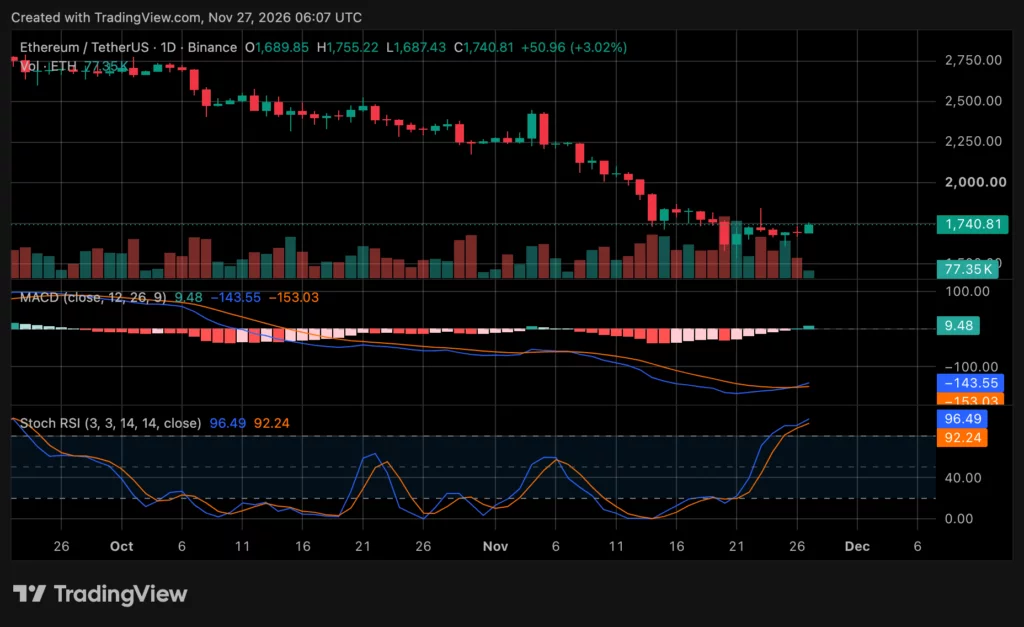
Separately, ETH rose 3% over 24 hours to $1,740 on November 27, outperforming Bitcoin during a broader market recovery. It traded between $1,670 and $1,750 over that period and remained about 65% below its August 2025 high of $4,950.