By November 25, 2026, borrowers had pledged about $19 million in Coinbase stock tokens to an Aave V4 lending market on Base and borrowed a cumulative $8.3 million in USDC, according to SeaLaunch. The market accepted eight stock tokens as collateral. A holder could borrow the stablecoin without selling the token, retaining exposure to the stock’s price while the token secured the loan.
What the stock tokens represent
Coinbase launched its tokenized stock product on Base, an Ethereum layer-two network, in August 2026. SeaLaunch described each stock token as a legal beneficial claim on underlying shares held one-for-one by a regulated, bankruptcy-remote custodian, separate from Coinbase’s operating assets. Holders could keep the tokens in their own wallets and settle transfers around the clock.
Within three months, the product had reached $45 million across nearly 400 U.S. stocks and exchange-traded funds, with more than 97,000 distinct holders. The largest tokens by value were Nvidia’s NVDAc at $10.9 million, Google’s GOOGLc at $10.4 million, Meta’s METAc at $5.4 million and the SpaceX-themed SPCXc at $4.2 million.
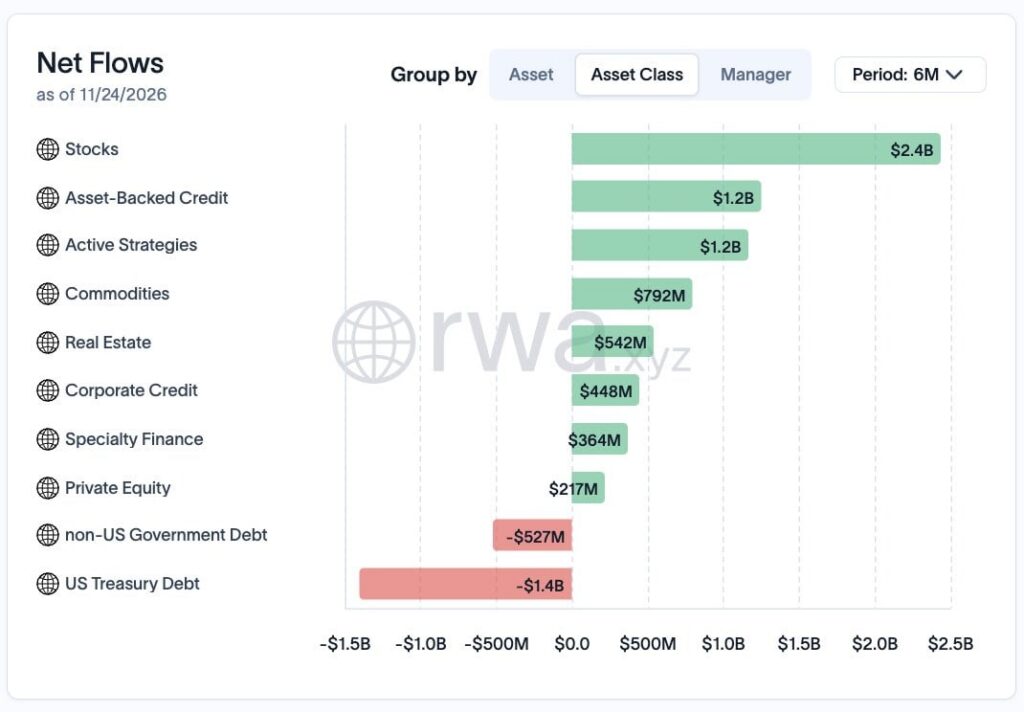
That growth came during a broader shift in flows. Over the preceding six months, tokenized stocks recorded $2.4 billion in net inflows, the most of any real-world asset category tracked by rwa.xyz, while tokenized U.S. Treasuries recorded $1.4 billion in net outflows.
One USDC pool, separate limits for each stock
Coinbase launched the dedicated Aave V4 market in late September 2026. Its hub is the single pool of USDC that funds loans. Its spokes set the rules for each stock token: how much of its value counts toward a loan, how much of the token the market will accept and when a position can be liquidated. Adding a stock therefore requires setting its risk limits, not finding a separate group of USDC lenders.
Loans have no fixed maturity. Borrowers can repay on demand, but they must keep the loan within the permitted share of their collateral’s value. If the stock falls, the debt can reach the liquidation threshold even if the borrower takes out no additional USDC.
The $19 million pledged represented about 40% of the value of Coinbase stock tokens in circulation. GOOGLc accounted for $6 million of collateral, followed by NVDAc at $5.1 million and METAc at $3.7 million. NVDAc deposits had used 73% of that token’s deposit cap, leaving 27% available. GOOGLc deposits had used 54%, leaving 46% available. Each other token had used less than 30% of its cap. These percentages measure how much collateral the market had accepted against each limit, not how much a holder could borrow.
How three vault managers used the market
SeaLaunch identified managed vaults as the main driver of borrowing. Three managers oversaw about $10 million across 22 stock-token vaults and supplied nearly one-third of the hub’s stock collateral. Their vaults pledged stock tokens, borrowed USDC and placed the borrowed funds in external stablecoin strategies. Alongside exposure to the stock price, each vault sought to earn the difference between the external strategy’s yield and the cost of borrowing from Aave. That difference is not a guaranteed return.
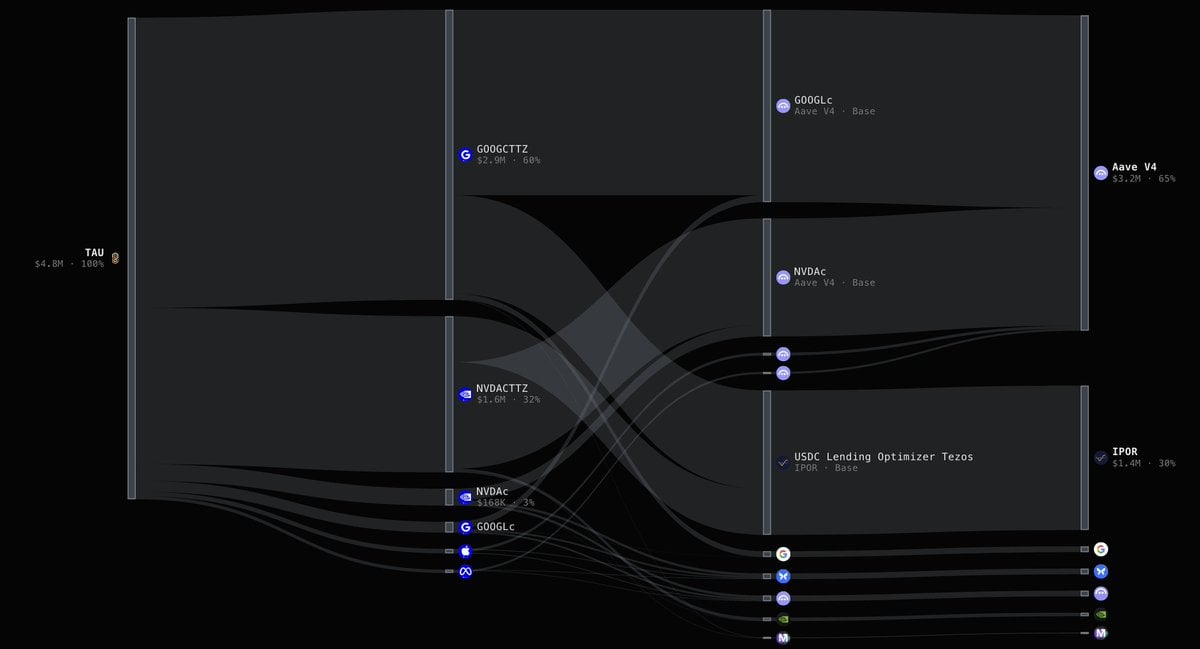
628 Labs (IPOR) — stock collateral and the USDC Lending Optimizer. The manager oversaw $4.8 million, concentrated in Google and Nvidia vaults. It allocated 65% to collateral on Aave V4 and 30% to IPOR’s USDC Lending Optimizer.
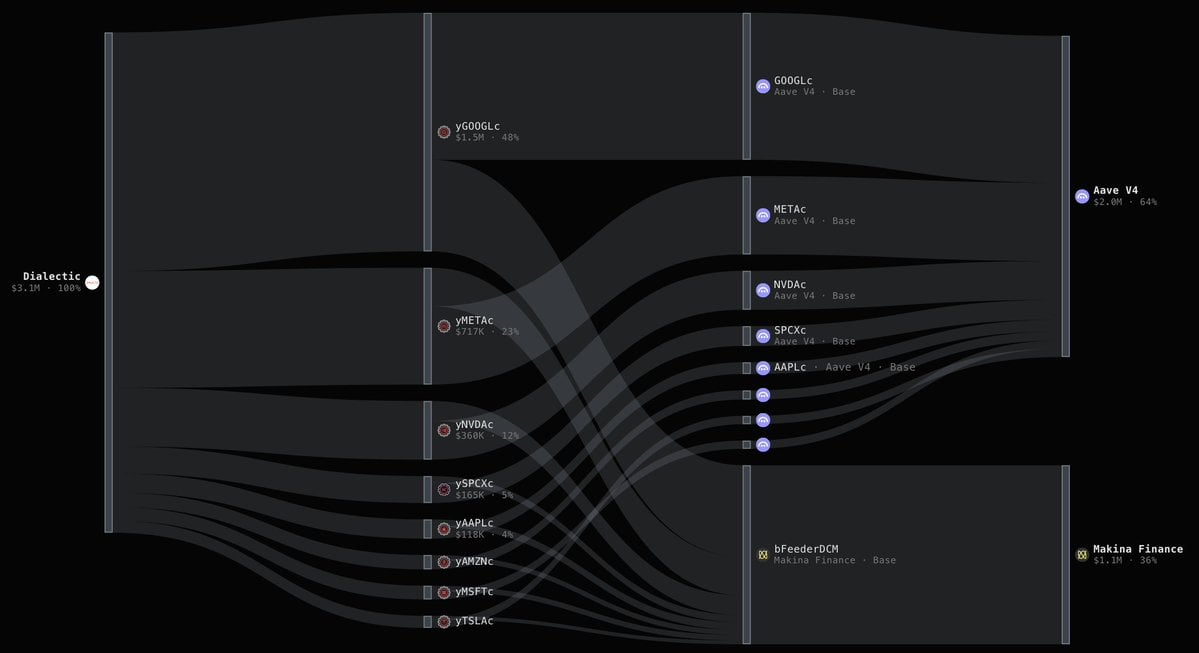
Dialectic Group — eight stock vaults split between Aave and Makina Finance. Dialectic managed $3.1 million. Its largest vault, yGOOGLc, held $1.5 million. Aave V4 collateral accounted for 64% of the allocation; the remaining 36% went to Makina Finance.
Superform — stock collateral and Clearstar’s USDC vault on Morpho. Superform managed $2.2 million across eight vaults, led by superNVDA at $680,000. It allocated 60% to Aave V4 collateral and 28% to the Clearstar USDC vault on Morpho.
A different use for stock collateral
SeaLaunch also described an equity-basis index that Keyring was developing with Bitget and its real-world asset platform, Reality. Unlike the Aave vaults, which retain stock-price exposure, the proposed index sought to offset it. It would pledge Reality-issued stock tokens in a permissioned lending market and take an equally sized short position in stock perpetual contracts on Hyperliquid.
The intended income would come from funding payments made by traders holding long contracts, after financing costs. That was the design of an index under development, not a reported return for index holders.