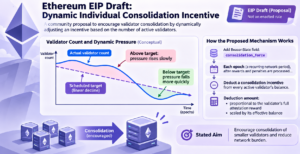
A draft Ethereum proposal would make it more costly to keep stake split across small validators. EIP-8502 is not an active rule: it proposes a balance deduction intended to encourage operators to consolidate validators, reducing the number of signatures the network must process.
In its November 19, 2026 report, TechFlow said researcher Anders Elowsson had submitted the consensus-layer draft. The report put the network at approximately 815,000 active validators and 44.01 million ETH staked as of that date, with an average effective balance of about 54 ETH per validator. The already-active EIP-7251 allows voluntary consolidation, but EIP-8502 proposes an economic incentive to use that option.
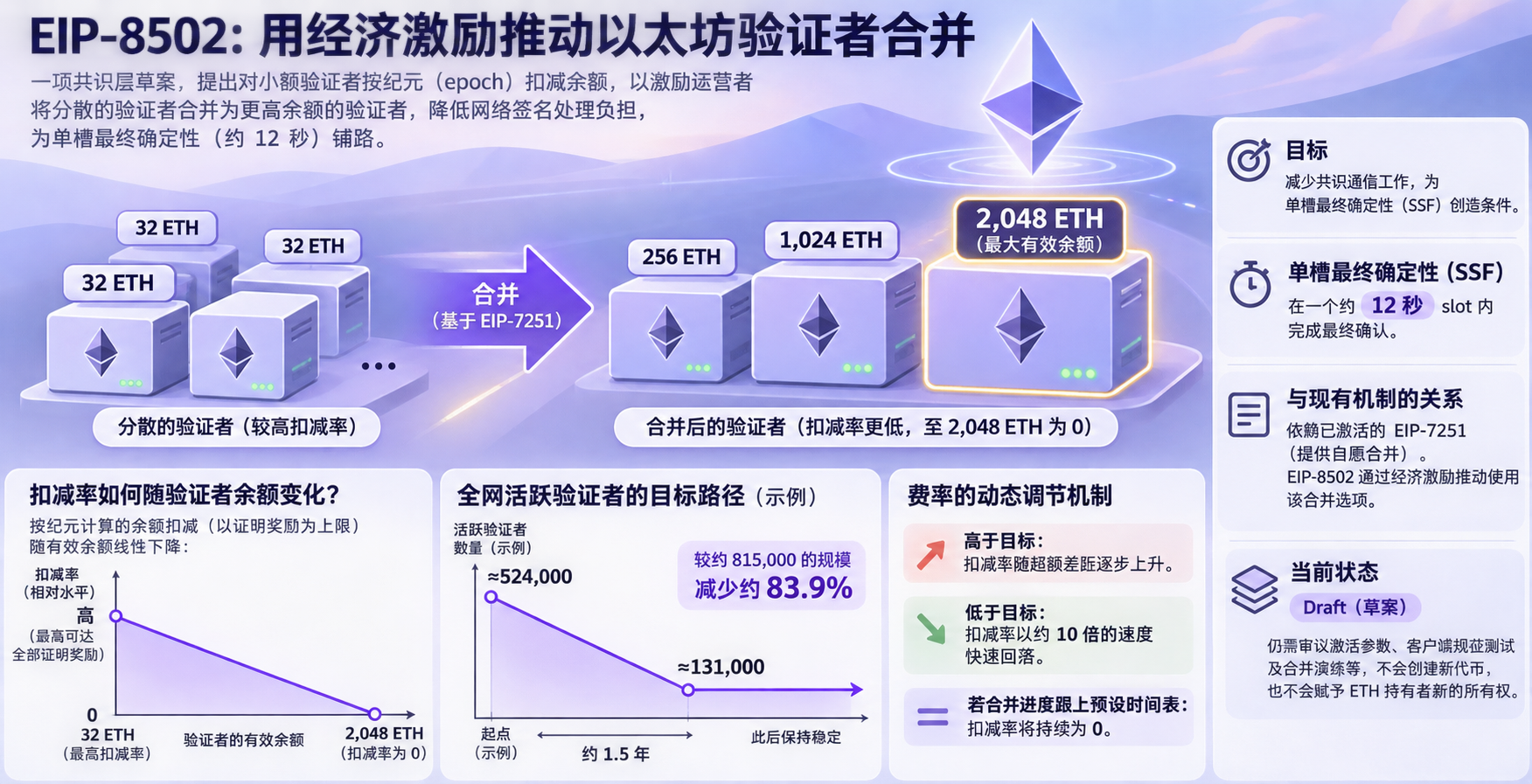
How the proposed deduction would work
The draft would calculate a deduction each epoch, based on a validator’s effective balance and how far the network’s active-validator count sits above its target. A validator at the 32 ETH threshold would face the highest rate; in an extreme case, the deduction could equal its full attestation reward—the reward for participating in consensus—not its entire staked balance. The rate would decline linearly as the validator’s effective balance increased, reaching zero at 2,048 ETH.
The proposal uses an illustrative target that falls from about 524,000 active validators to about 131,000 over roughly 1.5 years, then stays level. Compared with the roughly 815,000 validators reported on November 19, the lower figure would represent a reduction of about 83.9%. If the count exceeded its stage-by-stage target, the deduction would rise with the gap; below target, the rate would fall about 10 times faster. If consolidation kept pace with the proposed schedule, the deduction would remain zero.
The aim is to reduce consensus communication work as Ethereum researchers pursue single-slot finality: final confirmation within one approximately 12-second slot. The draft still requires review, including discussion of activation parameters, client-specification testing and consolidation exercises. It does not create a new token or grant ETH holders a new ownership right.