The New York Stock Exchange plans to use Avalanche technology to settle tokenized-stock trades on a forthcoming round-the-clock platform, according to a November 9 report and announcements cited by Foresight News. The platform was targeting a fourth-quarter launch but still needed regulatory approval when the original article was published on November 10, 2026, at 18:00 UTC+8.
The distinction for token holders is that tokenized shares and AVAX serve different purposes. The planned platform’s shares would be interchangeable with traditional shares and carry the same dividend and voting rights, according to the report. Neither NYSE’s nor Ava Labs’ announcement said AVAX would be used to settle trades, pay the platform’s transaction fees or secure its chain through staking.
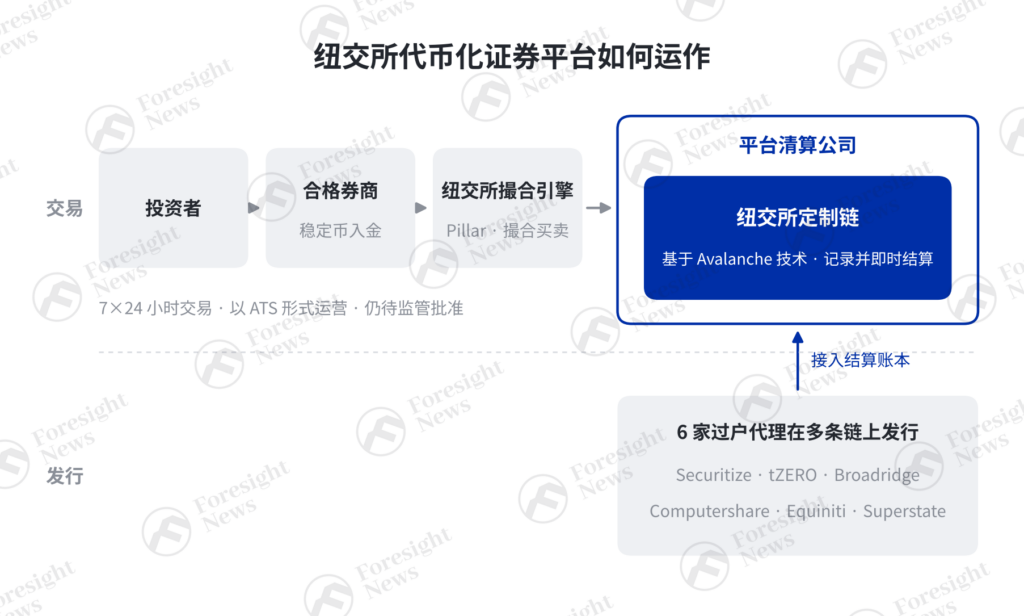
How the planned platform would work
NYSE’s existing Pillar engine would match trades. A clearing company would then record and settle them on an Avalanche-based ledger, while investors could fund accounts with stablecoins. Ava Labs chief business officer John Nahas said the ledger would be a blockchain customized for regulatory requirements—not settlement on Avalanche’s public C-Chain.
Shares could be issued across multiple chains and through different transfer agents, while trade records and settlement would be brought onto the dedicated ledger. On November 2, NYSE added Broadridge, Computershare, Equiniti and Superstate to Securitize and tZERO as transfer agents, bringing the total to six. NYSE digital issuance head Dennis Lee said the settlement ledger needed to be fast and reliable, control who could participate, offer predictable costs and have a large developer community.
That access control helps explain the choice of a dedicated Avalanche L1. Under Avalanche’s post-Etna, or ACP-77, model, an organization can operate its own validator set and make participation permissioned. Its validators do not first need to stake 2,000 AVAX as mainnet validators; instead, they pay a recurring fee.
Where AVAX enters the picture
According to Avalanche documentation cited in the report, when there are fewer than 10,000 L1 validators, each pays approximately 1.33 AVAX per month. Those payments are burned. They do not rise with the number or value of trades settled, and an L1 operator can choose a different token for fees within its chain.
The Avalanche Foundation has separately identified a gap between activity across its ecosystem and value captured by AVAX. In an August 12 estimate, it said C-Chain fee burns—not including L1 validator fees—had captured about $23.5 million since early 2024. L1 revenue sharing remained under study, with no established mechanism. Other ideas it listed, including validator votes on gas prices under ACP-283 and a protocol-owned stablecoin under ACP-67, were also research directions rather than implemented sources of AVAX revenue.
Under the mechanism described at publication, activity on NYSE’s proposed dedicated chain would therefore touch AVAX through its validator fees, not automatically through every stock trade. The platform’s launch and final operation remained subject to regulatory approval.
Source: odaily.news (originally published 2026-11-10 18:00 UTC+8)